When a child suffers from limb loss in a developing country, the absence of proper prosthetic care often means more than limited mobility. Oftentimes, it can mean isolation, lost education, and a life defined by dependence. The Limb Kind Foundation, founded by veteran prosthetist Rob Schulman, is changing that narrative. With over three decades in the field, Rob has devoted his career to helping children around the world regain movement, confidence, and comfort, one prosthetic at a time.
Limb Kind and ABCorp 3D share a unique partnership that bridges compassion and cutting-edge technology. By combining ABCorp 3D’s expertise in 3D printing with Limb Kind’s global mission, the two organizations are redefining what’s possible in prosthetic care. Leveraging the latest HP Multi Jet Fusion (MJF) technology and advanced 3D printing materials, custom-fit prosthetics can be produced faster, more efficiently, and for each individual’s exact needs. Together, they’re proving that innovation, when rooted in empathy, can change lives.
A Mission Born from Service
In 2010, after an earthquake devastated Haiti, Rob volunteered his expertise to assist children in need of prosthetic care. What began as a one-time trip became a calling.
“That trip was life-changing. I realized how much my services were needed outside the U.S.,” Rob recalls.
Inspired by the outpouring of support from colleagues and donors, he launched The Limb Kind Foundation in 2018. The mission was simple: bring teams, now compiled of prosthetists, technicians, therapists, and amputee mentors, to underserved regions and fit as many children as possible with new prosthetic limbs, free of charge.
Their first trip produced 33 prosthetics in one week. Today, Limb Kind operates teams of over 20 professionals who travel to countries including Haiti, the Philippines, Ethiopia, Kenya, Sri Lanka, and Zambia, fitting 50–60 children on each trip. “The kids leave with a whole new lease on life,” Rob says. “It’s life-changing, in the most literal sense of the phrase.”
The Challenge: Limited Access and Endless Need for Prosthetics
In many developing nations, children with limb loss have little access to even the most basic care.
“They don’t have wheelchairs or adaptive devices. If they’re lucky, they might have a homemade crutch made from sticks,” Rob explains. “Most can’t go to school or play with friends. They’re carried everywhere.”
Even when prosthetics exist, they’re often ill-fitting and painful. Local clinics may have only one or two trained professionals serving thousands of patients. The need is overwhelming and constant.
“I’ll never fulfill my goal,” Rob admits. “That’s what keeps me going. There will always be more children who need help.”
The Turning Point: Bringing Prosthetic 3D Printing into the Field
The Foundation’s early efforts relied entirely on traditional fabrication: hand-casting limbs with plaster, modifying them by hand, then laminating sockets with resin and carbon fiber. Each device could take a full day to complete, including downtime and drying time. Additionally, easily transporting those materials internationally? Nearly impossible.
“We can’t bring resin on planes, and plaster alone would fill almost all our allotted luggage,” says Rob. “It made scaling our efforts extremely difficult.”
In 2025, Limb Kind partnered with ABCorp 3D. After following prosthetic 3D printing technology for a few years, his interest was piqued by how HP MJF could modernize and accelerate prosthetic production. Additive manufacturing introduced a new level of precision, repeatability, and strength.
“Learning that these 3D-printed sockets could stand up to kids running, climbing, you know, being kids, that was huge,” he says.
The Solution: A Digital Workflow with Real-World Impact
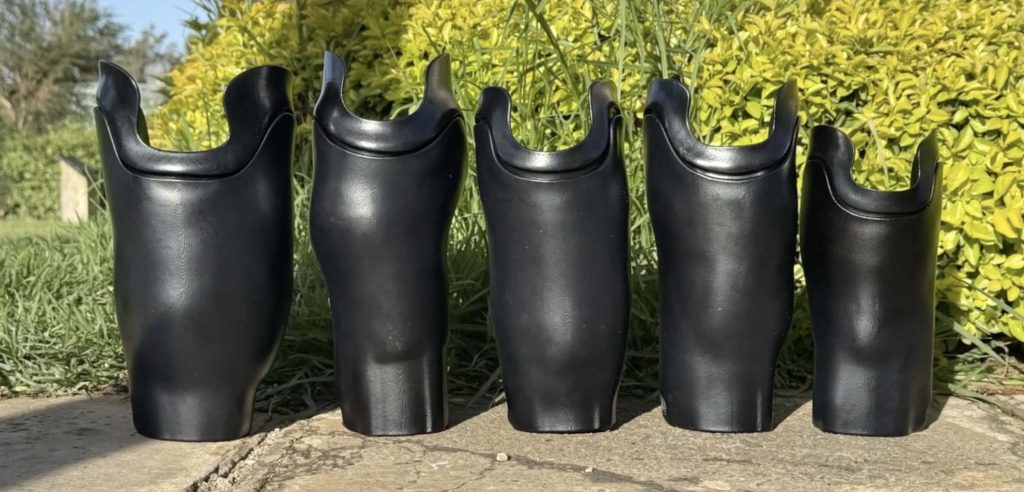
Today, the Foundation captures each child’s unique anatomy using 3D digital scanners, sending the scans to ABCorp 3D’s Boston facility for fabrication. MJF technology prints each prosthetic socket layer by layer, overnight.
“When we work by hand, we’re limited by the hours in a day, but these machines don’t sleep. They print around the clock,” says Rob. “The productivity is incredible.”
To support Limb Kind’s ambitious mission, ABCorp 3D stepped in not just as a manufacturer but as a true extension of the team. The partnership began in the spring of 2025, after Limb Kind had explored other prosthetic 3D printing options that ultimately fell short. ABCorp’s technology, workflow, and track record in additive manufacturing provided the reliability and scale the Foundation needed.
“When Limb Kind approached us, they had already tested other solutions that simply couldn’t meet the strength, consistency, or throughput these sockets require,” Neil Glazebrook, VP of 3D Solutions, said. “We knew we could help.”
ABCorp 3D received digital scans on a Sunday, and the team began building. The sockets were printed overnight, removed Monday morning, thoroughly cleaned, and AMT surface–smoothed to create a sealed, durable, antimicrobial finish. By 4:00 PM that same day, the completed sockets were packaged and ready for international transport.
A fully customized, production-ready device, delivered in under 24 hours.
“This is exactly why additive manufacturing matters,” Neil added. “When a mission is urgent, we’re proud to use our technology to help scale.”
That difference became unmistakably clear during a recent mission trip. As the team’s traditionally fabricated sockets were still being sanded, buffed, and polished, their 3D-printed sockets had already completed a journey from Boston to Africa.
Produced on ABCorp 3D’s MJF systems, packed, and shipped across the ocean, the digital sockets arrived fully finished and ready for fitting before the hand-built ones were even complete.
“I’ll never forget standing there that morning,” Rob shares. “In my left hand was an ABCorp socket that had been printed, polished, shipped over 24 hours, and was ready to go. In my right hand, I held one of our traditional sockets that still needed hours of smoothing and shaping. The 3D-printed one was done first, despite traveling halfway around the world.”
Results: Faster, Stronger, Kinder
By shifting part of its workflow to digital production, Limb Kind has realized several key benefits:
- Time savings: Dramatically shortened fabrication timelines, enabling more children to receive devices during each mission.
- Precision and consistency: Digital scanning ensures precise measurements and consistent results from one device to the next.
- Strength and durability: MJF materials withstand the demands of active children in harsh environments.
- Scalability: By removing material and logistical barriers, the digital workflow enables the team to produce more prosthetics in the same amount of time, ultimately helping more children on each trip.
“The accuracy and consistency are undeniable,” Rob says. “Digital manufacturing lets us replicate that perfect fit again and again.”
Looking Ahead: Scaling Compassion
Rob’s vision for the future merges technology and empathy. The Foundation aims to expand into new countries, including Zimbabwe, Malawi, Sierra Leone, and the Dominican Republic, while exploring partnerships in which social enterprise donors could help fund additional HP MJF systems dedicated to humanitarian work.
“Imagine a donor purchasing a machine that uses 25% of its production to make prosthetics for children,” Rob explains. “The rest could support their own commercial work. Everyone wins.”
For Rob, the mission has no endpoint.
“I’d love to see every child with limb loss have a prosthesis,” he says. “That’s the dream, and it’s one we’ll never stop chasing.”
We are proud to be part of a mission that brought mobility, dignity, and hope to children in Kenya. It’s a powerful example of what can happen when compassion and innovation come together to solve real-world challenges.
About the Limb Kind Foundation
Founded in 2018, the Limb Kind Foundation is dedicated to improving the lives of children with limb loss, both domestically and internationally, by strengthening the amputee community and providing prosthetic care to all. Through global medical missions and domestic outreach, their volunteer teams deliver hope, independence, and mobility.