Offering sustainable or eco-friendly payment cards is about more than just the physical materials they are made of. Recycled plastic or plant-derived card bodies are a step in the right direction, but there are many elements that contribute toward manufacturing payment cards that are gentler on the environment.
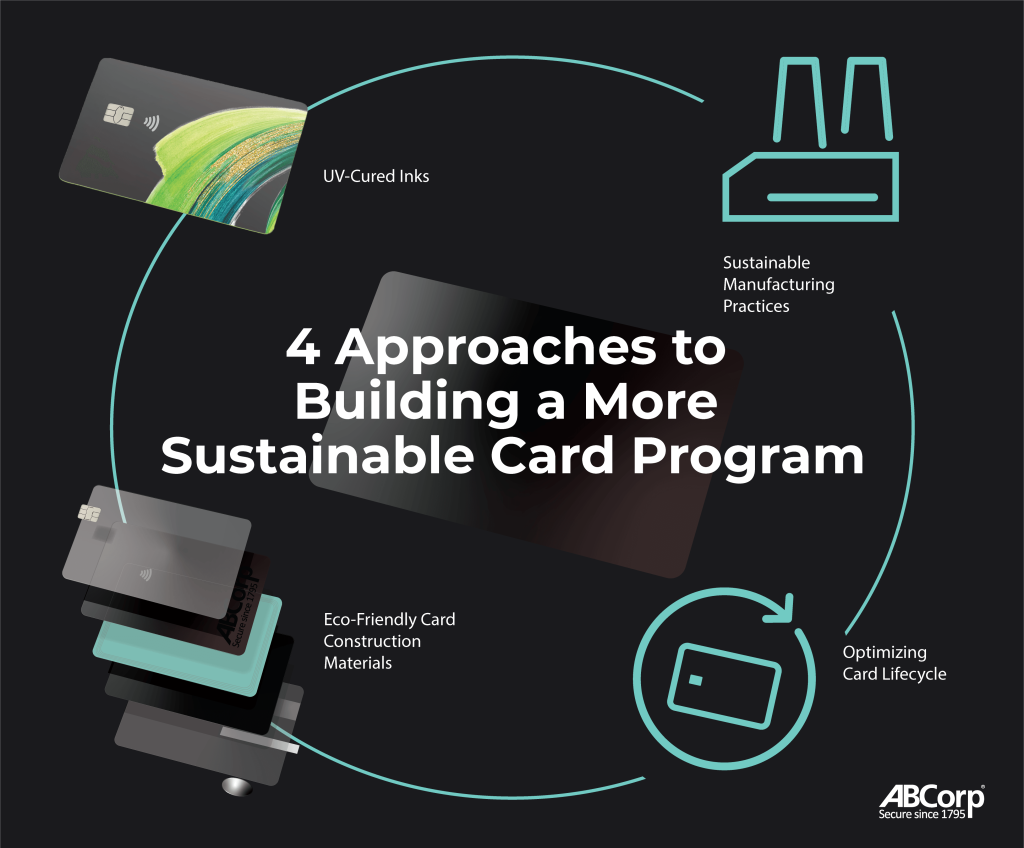
A credible approach to sustainable payment card programs considers the full card lifecycle. This includes responsible construction materials, from recycled plastic and non-plastic choices to the types of inks selected for printing. Then there is the equipment used to manufacture the cards, how those machines are powered, and the amount of excess waste they produce. Another consideration is the durability of those cards and reducing the need for replacements across their life spans. Let’s take a closer look at these four areas of sustainability for payment card manufacturing.
1. Sustainable Card Manufacturing Begins With Card Body Materials
The raw materials that comprise a payment card pose an undeniable impact on the environment. However, payment cards must also be built to withstand the impact of everyday use and have the physical longevity to serve throughout the card’s entire lifecycle. As innovation continues to offer more choices for card construction materials, their usage must be balanced with real-world wear-and-tear.
Popular options for payment card bodies that offer an alternative to first-use PVC include the following:
- Recycled PET (PolyEthylene Terephthalate) is one of the most recycled and recyclable plastic choices available. rPETG is strong and lightweight, while providing the durability needed for frequent card usage.
- Recycled PETG (Polyethylene Terephthalate Glycol) is another plastic that offers durability, quality, and recyclability benefits that can be leveraged for payment card manufacturing.
- Recycled PVC (Polyvinyl Chloride) reduces the consumption of first-use PVC while maintaining its versatility, durability, and cost-effective nature.
- Polyactic (PLA) is a bio-based thermoplastic that leverages renewable natural materials for its construction while also offering the benefit of being biodegradable.
Selecting the right material for a sustainable payment card program will depend on a variety of factors including cost, ease of procurement, production time, and durability requirements.
2. Selecting Eco-Friendly Printing Inks for Credit Card and Debit Card Manufacturing
Printing inks can also have a significant impact on the environment, especially for large payment card programs. More and more payment card manufacturers are moving toward UV-cured inks that produce high quality prints with lower environmental impact. In addition, this reduces dependency on oil-based printing inks and the special considerations associated with their production, procurement, storage, and disposal.
3. Sustainable Credit Card Manufacturing Requires Capital Investment, Not Just Materials
Sustainable payment card manufacturing goes beyond the physical elements that construct the card. It’s also about the machinery and efficiency of the production process to ensure that the environmental impact is as limited as possible.
Manufacturing credit cards and debit cards requires a precise, carefully orchestrated process that relies on heavy machinery. Due to the nature of the work and high output, this machinery draws heavily on power sources. Energy-efficient manufacturing equipment is imperative to reduce the burden on power sources, and many manufacturers have made the move toward electric powered machinery to reduce the environmental impact. When manufacturers also invest in solar panels to power this machinery, the ability for self-sustained energy consumption becomes real.
Investments in the latest machinery are also critical to reduce scrap and waste during production. Today’s generation of machinery is built to improve production quality, reduce time, limit resource consumption, and eliminate unnecessary waste.
4. Card Durability Matters: The Role of Contactless Payments in Sustainability
While material selection, printing inks, and manufacturing practices are the foundation of a sustainable payment card program, the next critical factor is how long cards remain in circulation. Reducing the need to reissue cards and optimizing the card lifecycle naturally reduces their environmental impact.
Contactless smart card manufacturing naturally reduces wear-and-tear by reducing payment cards’ physical interactions with point-of-sale systems. Inserting a credit card or debit card into a card reader will take a physical toll on the card with repeated, high-frequency usage. However, embedding that card with a contactless antenna and EMV chip can reduce or eliminate those interactions by leveraging tap-to-pay.
While the antenna and chip require additional card construction materials, there are eco-friendly alternatives here as well. Greener chip options are available featuring an encapsulated module that combines the antenna and chip in one unit. This alternative reduces material usage and promotes sustainability by giving cardholders the ability to remove the chip and recycle the card body when the payment card reaches the end of its lifecycle.
How does ABCorp partner with payment card programs to deliver sustainable cards?
When it comes to building sustainable payment card programs for your organization, partner with ABCorp to ensure that your cards match your portfolio’s eco-friendly initiatives. ABCorp’s card issuance experts will work with you to build a plan by:
Identifying key eco-friendly card manufacturing materials
Not all sustainable card materials behave the same way. Our experts at ABCorp understand these materials and offer a suite of solutions to enhance your card’s performance needs.
Choosing eco-friendly UV-cured inks that set your cards apart
ABCorp offers UV-cured inks that will take your eco-friendly card program to the next level.
Executing card production that enhances sustainability
When it comes to payment card programs, greener card manufacturing takes careful planning. ABCorp facilitates eco-friendly manufacturing practices while also delivering cards on time and on budget.
ABCorp manufactures durable, contactless EMV cards your customers can rely on
Payment card construction can only be as sustainable as the length of their lifecycles. ABCorp partners with payment card programs to build durable cards leveraging contactless, tap-to-pay technology that keeps cards top-of-wallet.
Payment card programs must consider a myriad of components in determining the sustainability of their card portfolios. In doing so, they can prioritize initiatives that deliver measurable environmental benefits while optimizing cardholder experiences. Sustainable payment card programs may begin with the responsible selection of card body materials and printing inks, but they succeed over the long term by optimizing durability throughout the entire card lifecycle.