If you feel a sense of déjà vu reading semiconductor headlines lately, you’re not imagining it. The supply chain pressures that disrupted industries from 2020 through 2022 are returning. While today’s headlines may be quieter than those surrounding COVID-related shortages, there are real implications for card program managers that depend on secure EMV chips.
This blog provides an overview of current supply chain limitations to help inform procurement teams, card program managers, and technology partners that rely on chip-based card and credential products. The positive news is that the situation is manageable for card program managers that act now before the situation worsens.
What’s Happening in the Supply Chain
Lead times for secure microcontroller chips (the kind embedded into payment cards, transit cards, and secure credentials) have extended significantly over the past several months. Leading suppliers are seeing wafer fabrication lead times stretch from approximately 12 weeks to around 16 weeks. When you add four weeks for module packaging and one to two weeks for logistics and fulfillment, total end-to-end delivery timelines are now approaching 20–22 weeks, or roughly five months.
For context, a 20-week lead time means that net new orders placed at the time this blog post was published are unlikely to arrive until late summer at the earliest. For programs with rolling card issuance commitments or expiration-driven reissuance cycles, this math deserves serious attention.
What’s driving delays for secure microcontroller chips?
The pressure isn’t coming from a single source. Rather, it’s a convergence of several macro forces, including:
1. Insatiable demand from artificial intelligence and data infrastructure. Global semiconductor fabrications are operating under extraordinary demand from the artificial intelligence and high-performance computing sectors. According to the Semiconductor Industry Association, global chip sales reached $627 billion in 2024, driven significantly by AI accelerator demand. Foundries like TSMC and Samsung are prioritizing advanced node capacity, which creates ripple effects across the broader chip ecosystem. This includes the mature nodes used in secure element manufacturing.
2. Bottlenecks in back-end processes. The constraint isn’t only in wafer fabrication. Testing, assembly, and packaging, collectively called OSAT (outsourced semiconductor assembly and test), remain a significant chokepoint. A 2024 report from Gartner noted that OSAT capacity expansion lagged front-end production investment for years, creating a structural imbalance that is now materializing as real-world delays. These back-end steps cannot be easily accelerated, making lead time compression a significant hurdle in the near term.
What it Means for EMV Chip Pricing for Card Programs
This tightening of supply also drives prices upward resulting in a pricing increase of approximately 10% across certain secure chip categories, affecting both existing backlog and new orders. This is consistent with broader industry dynamics in that when allocation becomes constrained, spot and contract pricing typically move in tandem.
For organizations running large-volume card programs, even modest per-unit cost increases can translate into significant budget impacts at scale. A 10% increase on a 500,000-unit program at $1.50 per chip module represents $75,000 in incremental spend before downstream costs from production delays are even factored in.
The Strategic Shift: From Reactive to Proactive
Oftentimes, the instinct in supply chain management is to only order when you need. That model breaks down when lead times approach five months. Organizations that continue to operate reactively and order only as demand materializes will find themselves competing for constrained allocation and paying elevated prices when supply is tightest.
The organizations that fare best in constrained supply environments share a common approach in that they lock in forward demand early, secure allocation before tightening accelerates, and treat supply assurance as a core program management function rather than a logistics afterthought. Research from McKinsey & Company on supply chain resilience found that companies with proactive procurement strategies recovered from supply disruptions significantly faster and at lower cost than those relying on reactive ordering.
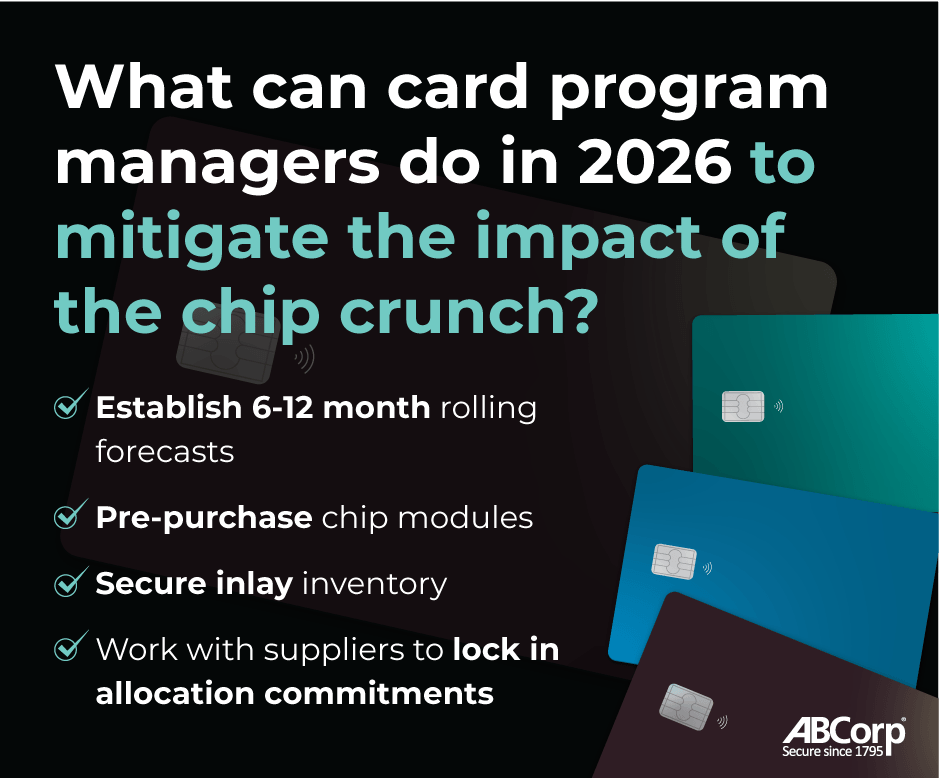
What can card program managers do now to help prevent the downstream effects of today’s constrained environment?
- Establish 6–12 month rolling demand forecasts and share them with supply partners.
- Pre-purchase chip modules against forecast where inventory carrying costs are manageable.
- Secure inlay inventory ahead of further lead times or price movements.
- Work with suppliers to lock in allocation commitments before peak demand periods.
Doing so will help your card program achieve these three goals:
- Supply assurance: Ensuring your program has the chips it needs, when it needs them, without last-minute scrambles or production gaps.
- Cost predictability: Locking in pricing before further escalation, which is particularly relevant for programs with fixed-fee or multi-year pricing commitments to end customers.
- Priority allocation: Prioritizing customers with committed forecasts, creating a meaningful operational advantage when supply is tight.
Investing in forward inventory now can be substantially cheaper than managing a supply interruption, both in direct costs and in the operational disruption that follows.
How can card program managers be proactive about their procurement strategies in 2026?
If you operate a card program with ongoing chip-dependent issuance, now is the time to take stock of your forward demand and have a direct conversation with your supply chain partners. Specifically:
- Review your card issuance forecast for the next 6–12 months.
- Identify programs with expiration-driven reissuance requirements, as these are the most time-sensitive.
- Engage your chip and/or inlay suppliers on current lead times and pricing outlooks.
- Assess where pre-purchase commitments make financial and operational sense.
The semiconductor cycle has experienced disruptions before, and it will turn again. But programs that position themselves with secured supply and predictable costs are well positioned to navigate this period with far greater confidence than those who wait and react.
Ready to prepare your card program for supply chain fluctuations? Contact ABCorp.