La plupart des titulaires de cartes ne pensent jamais à ce qu'il faut pour mettre de l'encre sur une carte de paiement physique. Cependant, le processus d'impression est une décision importante pour les gestionnaires de programmes de cartes de toutes les industries, compte tenu de son impact sur les coûts de fabrication et les délais. Le processus d'impression façonne l'aspect physique et le toucher des cartes CR80 finies, la vitesse à laquelle elles peuvent être fabriquées et accompli, ainsi que leur durabilité globale tout au long de leur cycle de vie, que ce soit dans les portefeuilles des titulaires de cartes ou lors de leurs interactions avec les terminaux de paiement (TPE) sur le terrain.
Les deux principales méthodes d'impression utilisées pour fabrication de cartes de paiement physiques sont l'impression lithographique et l'impression numérique. Comme pour toutes les décisions de fabrication, il existe des avantages et des inconvénients à examiner attentivement pour chaque option. Comprendre les forces et les limites de ces deux méthodes peut aider les gestionnaires de programmes de cartes à travailler plus efficacement avec les fabricants de cartes et à définir des attentes appropriées pour le produit fini.
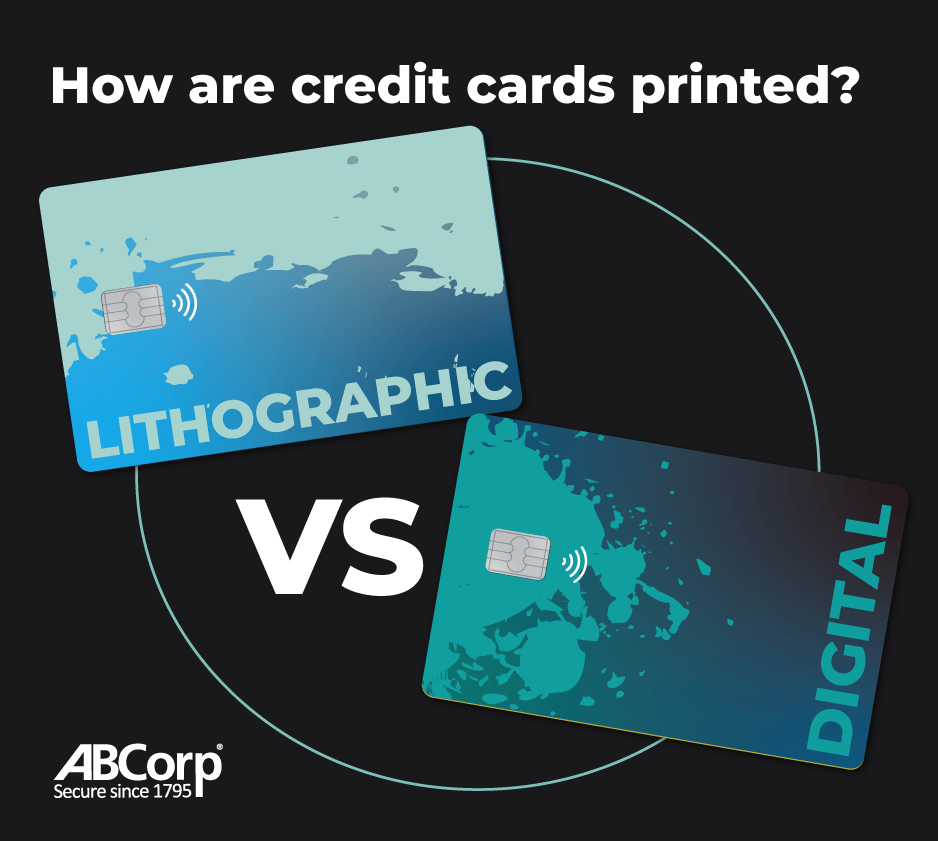
Quel est le processus d'impression des cartes de débit et de crédit ?
Avant de commencer la comparaison, il est utile de comprendre ce qu'implique réellement l'impression d'une carte de paiement physique. Une carte de paiement n'est pas imprimée de la même manière qu'une brochure en papier, par exemple. Le corps de la carte, généralement en empilement laminé de couches de plastique, doit conserver une fidélité des couleurs précise sous l'effet de la chaleur, de la pression et de la manipulation quotidienne. Les encres doivent adhérer aux substrats de carte sans craquer, se décolorer ou s'écailler pendant la durée de vie de la carte. Le processus d'impression de la carte de crédit a lieu avant la plastification, la personnalisation avec des éléments tels que le nom du titulaire de la carte et le CVV, et Puce EMV ou intégration d'antenne, ce qui signifie que tout défaut dans la couche d'impression se reporte plus loin dans la chaîne de production.
Dans cette optique, le choix de la méthode d'impression relève moins de la préférence que de ce qu'exige le programme.
Impression lithographique pour cartes de paiement : forces et limites
L'impression lithographique, également appelée impression offset, utilise une série de plaques pour transférer l'encre sur le substrat de la carte. Chaque couleur du dessin nécessite sa propre plaque, et les plaques sont appliquées séquentiellement pour construire l'image finale.
Quels sont les atouts de la lithographie pour les cartes de paiement ?
- Précision et cohérence des couleurs.
L'impression lithographique produit une correspondance des couleurs exceptionnelle, ce qui est important lorsque l'identité d'une marque dépend de l'atteinte d'une teinte spécifique sur des millions de cartes. Le rendu des couleurs a tendance à être constant, hautement reproductible et peut être exécuté à grande échelle.
- Efficacité des coûts pour les séries à haut volume.
Une fois les plaques fabriquées, le coût unitaire diminue considérablement. Pour les programmes de cartes importants émettant des centaines de milliers de cartes, l'impression lithographique est généralement l'option la plus économique.
- Qualité d'impression sur des designs complexes.
Les dégradés subtils, les effets métalliques et les motifs de fond détaillés ont tendance à être reproduits de manière plus fiable avec l'impression offset, en particulier pour les finitions spéciales.
Quelles sont les limites de l'impression lithographique pour les cartes de crédit et de débit ?
- Frais d'installation initiaux.
La production de plaques prend du temps et augmente les coûts. Pour les petites séries ou les programmes de test de nouvelles conceptions de cartes, cet investissement de mise en place peut être prohibitif.
- Flexibilité de personnalisation limitée.
Si vous souhaitez des données variables, des variations régionales de cartes ou des modifications de conception en cours de tirage, l'impression lithographique n'est probablement pas la meilleure option. Les plaques sont statiques et une fois configurées, elles s'appliquent à l'ensemble du tirage et ne peuvent pas être modifiées en cours de route.
- Délais plus longs.
Le travail de prépresse, la création de plaques et la mise en place de l'imprimante font que le cheminement de la maquette approuvée à la production de cartes prêtes à imprimer prend plus de temps que les alternatives numériques. Pour les programmes de cartes qui reçoivent des commandes à court terme et doivent fabriquer des cartes rapidement, l'impression offset peut ne pas être la meilleure option.
Impression numérique pour cartes de paiement : atouts et limites
L'impression numérique applique l'encre directement sur le substrat à l'aide de systèmes à jet d'encre ou laser, sans nécessiter de plaques. Le motif est envoyé numériquement et la presse l'imprime directement.
Quels sont les avantages de l'impression numérique pour les cartes de paiement ?
- Vitesse et flexibilité.
Sans clichés, la mise en place est minimale. Les changements de conception peuvent être réalisés rapidement, et les petites séries deviennent économiquement viables. Pour les programmes pilotes, les cartes en édition limitée ou les variations régionales, l'impression numérique peut être un excellent choix.
- Personnalisation et données variables.
Les presses numériques peuvent imprimer des éléments variables au sein d'une même série, permettant ainsi de produire plus facilement des designs individualisés ou des variantes de cartes spécifiques à une région à grande échelle.
- Barrière plus faible pour les petits programmes.
Les coopératives de crédit et les banques locales ayant des volumes d'émission plus faibles trouvent souvent l'impression numérique plus accessible, avec des quantités minimales de commande plus faibles et des délais d'exécution plus rapides.
Quelles sont les limites de l'impression numérique pour les cartes de crédit et de débit ?
- Correspondance des couleurs à haut volume.
La reproduction fidèle des couleurs lors de tirages très importants peut être plus difficile à maintenir avec l'impression numérique qu'avec les méthodes lithographiques. Pour les marques ayant des normes de couleur strictes, cette barrière peut être difficile à surmonter.
- Limitations du substrat et de la finition.
Tous les matériaux et finitions spéciaux ne sont pas compatibles avec les presses numériques. Les corps de carte métalliques, certains substrats texturés et certaines finitions haut de gamme peuvent nécessiter une impression offset.
- Coût unitaire à l'échelle.
À mesure que les volumes augmentent, le coût unitaire de l'impression numérique a tendance à rester stable ou à diminuer lentement, tandis que la courbe des coûts de l'impression lithographique a tendance à baisser fortement. L'économie de l'impression numérique pourrait finalement ne pas être financièrement judicieuse pour les grands programmes de cartes.
Quelle méthode d'impression est la plus adaptée pour la fabrication de cartes de crédit et de débit physiques ?
| Lithographie | contre. | Impression numérique |
|---|---|---|
| Rentable pour l'impression à grand volume | Cost | Cost-effective for low-volume printing |
| Reliable for color accuracy and specialty finishes | Quality | Limited color accuracy for higher volumes; not all finishes are compatible |
| Optimal for large card programs | Quantity | Optimal for smaller card programs |
| Static plates prohibit use of variable data | Personalization | Prints variable elements within a single run |
| Limited customization with higher setup costs | Customization | Quickly and easily prints individualized or region-specific designs |
The right method depends on your program’s priorities. A large financial institution rolling out millions of consumer debit cards with a fixed design has different needs than a credit union launching a limited co-branded card or a fintech testing a new card product.
When it comes time to discuss printing techniques with your card manufacturer, enter the conversation prepared with answers to the following questions:
- What is your physical card program’s projected annual issuance volume?
- How frequently does your card program print new designs and/or regional variants?
- Do you have strict brand color standards that require color matching?
- What is your lead time expectation from design approval to card delivery?
The right card solutions partner will work through these questions with you rather than defaulting to a single printing method. The best programs are built on the right combination of capabilities, and it’s imperative to work with a provider that offers choice.
At ABCorp, our physical card manufacturing capabilities include both lithographic and digital printing. We work with card program managers to understand their needs and pick the right option for their volumes, timelines, and design requirements.