If you’re comparing injection molding versus 3D printing (also known as additive manufacturing), you’re not alone. These two methods dominate modern production, but solve different problems.
In a world where design cycles are accelerating, products are hyper‑customized, and teams need to move faster while staying cost‑conscious, 3D printing is coming to the forefront. It’s no longer just about prototyping; it’s about real, production‑ready manufacturing.
Here is a breakdown of how injection molding and additive manufacturing work, and why more manufacturers are turning to industrial 3D printing services for the agility, speed, and complexity that molded parts can’t match.
How Injection Molding Works
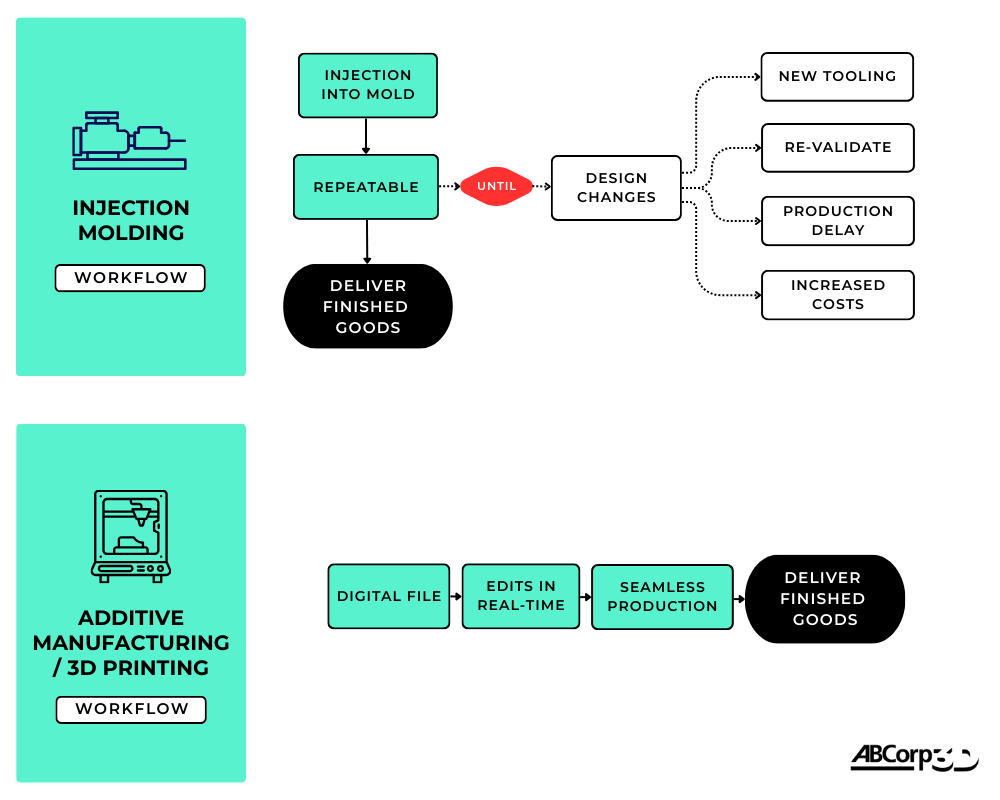
Think of injection molding as the legacy workhorse of manufacturing. It’s been around for decades, there’s deep familiarity with it, and it’s excellent at one thing: making the same part, repeatedly, at high volume. But the path to get there? Unfortunately, it’s not seamless.
1. You Need a Mold…and It’ll Cost You
The costs of tooling can add up quickly. For many projects, you can’t start production until you’ve invested in building the mold. This makes injection molding impractical for teams that need flexibility or are exploring early‑stage production.
2. Every Design Change Pauses Production
With injection molding, it’s repeatable… until it isn’t.
New design? Requires new tooling. New tooling? Requires new validation. New validation? New delays and higher costs. What should be a simple design tweak becomes a multi‑week (sometimes multi‑month) detour. This is why many teams explore rapid prototyping services or a rapid prototyping service bureau before locking in a final molded design.
3. Complexity = Cost
Curves, hollow structures, internal channels, lattice patterns, really anything beyond simple geometry, become difficult, expensive, or impossible with molding unless you add specialized inserts or multi‑part tooling.
Additive Manufacturing: Fast, Lean, Adaptable Production
Additive manufacturing doesn’t rely on molds at all. Instead, parts are built layer‑by‑layer directly from a digital file, a process central to modern industrial additive manufacturing systems. This shift from physical tooling to digital workflows fundamentally changes how products are designed and produced. Many companies access this capability through a 3D printing or rapid prototyping service bureau rather than investing in equipment up front.
1. No Molds, Tooling, or Upfront Investment
Your CAD file becomes your production tool. With 3D printing production services, teams skip weeks of waiting and move straight into manufacturing.
2. Design Changes Happen in Real Time
Need to strengthen a section? Update a tolerance? Add a logo? Improve ergonomics?
You simply update the file and print again. No downtime. No unexpected tooling costs. This is why MJF (multi jet fusion) 3D printing services and other industrial additive technologies are widely used for both prototyping and end‑use production.
3. Complexity Is Free
Where molding penalizes complexity, additive manufacturing embraces it.
Think:
- Curved geometries
- Lightweight lattice structures
- Custom‑fit forms
- Internal channels
- One‑piece assemblies
If you can design it, a qualified additive manufacturing spartner can likely produce it.
4. Production Is Faster, Leaner, and More Adaptable
Additive manufacturing isn’t here to replace molding for million‑unit runs, but it excels in low-to-mid-volume production, bridge manufacturing, and the production of customized parts. Many manufacturers rely on large‑scale 3D printing services or large 3D printing companies to support these needs without long lead times.
Injection Molding vs Additive Manufacturing: A Side‑by‑Side Comparison
| Category | Injection Molding | Additive Manufacturing |
|---|---|---|
| Upfront Costs | High $$$ (Tooling Required) |
Low $ (No Moldes) |
| Speed to First Part | Weeks to Months | Hours to Days |
| Design Flexibility | Low | Very High |
| Cost Per Part | Low at Mass Scale | Consistent at low-mid volumes |
| Best For | Millions of Identical Parts | Iterations, Custom Parts, Small-Mid Runs, Complex, Geometries |
| Adaptability | Slow | Instant |